


how to install Embroidery Fabrics · Process Types & Apparel Applications? | Jiede Fabric

1. Embroidery Fabric: Definition, Supply Forms and Classification
1.1 What is embroidery fabric
Embroidery fabric is base cloth onto which patterns are stitched thread by thread, usually combined with sequins, beads, ribbons, cords or padding. It differs from printing at the root: printing adds colour, so the cloth keeps its original thickness; embroidery adds thread, building real thickness, direction and light play that can be felt with the fingers.
Because it adds thread rather than colour, embroidery also delivers three functional effects beyond decoration: reinforcement where stitch density is high; joining, where applique or tape embroidery fixes one material onto another; and structure, where eyelet and water-soluble embroidery create real openings that give transparency and breathability.
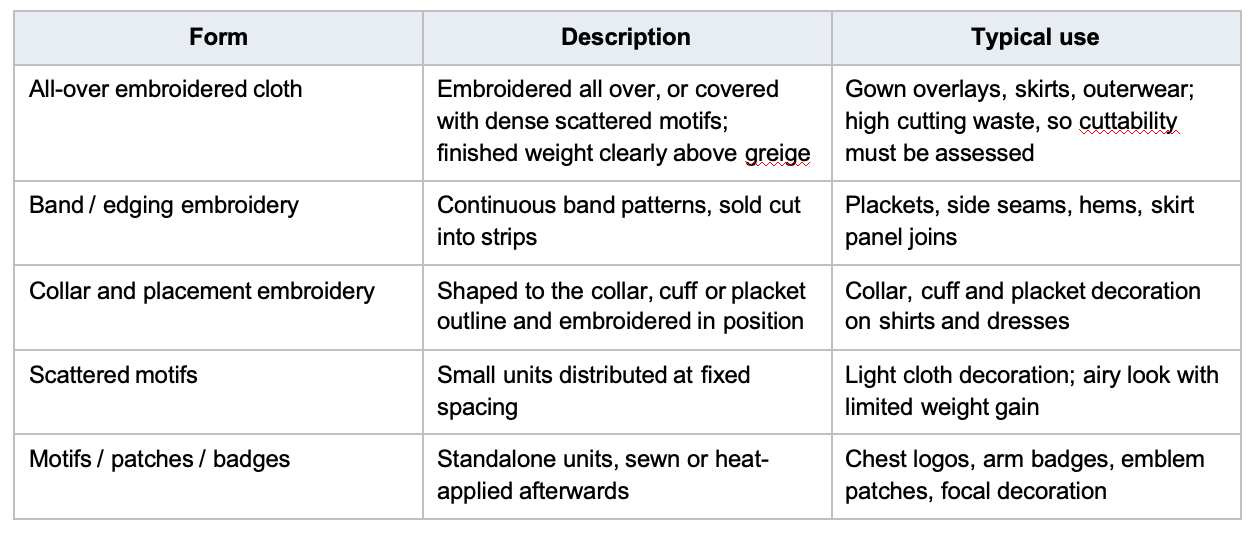
One common misunderstanding should be cleared up first: embroidery is not only a garment-making step. It can be done on the full piece of fabric (the embroidery fabric itself is then delivered to the garment factory for cutting), or it can be positioned on cut panels or on a finished garment. The same artwork executed as piece embroidery or as panel embroidery gives completely different appearance, cost and cutting waste - so the supply form must be fixed at development stage.
1.2 Three supply forms
· Piece embroidery (full-width): the base cloth is delivered to the embroidery mill in the piece and embroidered all over, or into bands and edgings. The finished goods are supplied as fabric for cutting. Best unit cost, suited to continuous patterns and high volumes.
· Panel embroidery (positioned): panels are cut to pattern first, then embroidered in position. Placement is accurate and irregular outline patterns are possible - ideal for positioned motifs, collar and chest designs - but it demands tight coordination between cutting and layout.
· Motifs, patches and badges, plus garment embroidery: small units are embroidered separately and then sewn or heat-applied onto the garment; garment embroidery is stitched directly onto a finished garment, typically for small logos and accents.
1.3 Classification framework
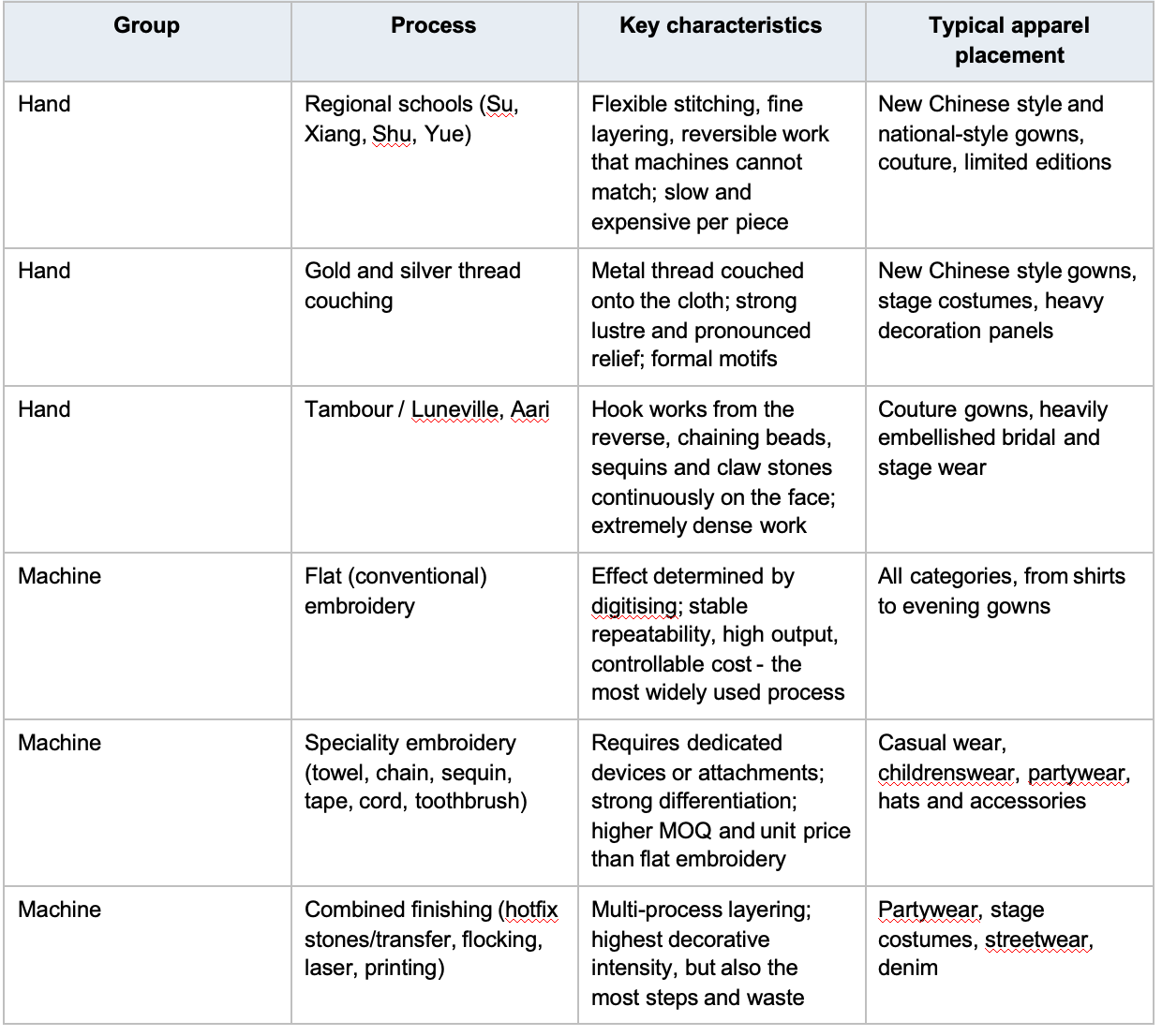
The trade classifies embroidery first by production method - hand embroidery and machine (computerised) embroidery. Machine embroidery is then divided into conventional embroidery (the flat-stitch family) and speciality embroidery, the latter requiring dedicated devices or attachments such as sequin, towel, chain, tape and cord embroidery. This document follows that convention and adds a third group: combined processes, where embroidery is layered with printing, hotfix stones, laser cutting or flocking.
A note on hand embroidery: the four famous Chinese regional schools (Su, Xiang, Shu and Yue) belong to an artistic tradition rather than to industrialised production; they are described here only in terms of application, without comparing techniques.
2. Overview of Process Types
2.1 By production method
The table below is the top-level classification of embroidery processes - a common reference frame for discussions with buyers and embroidery mills.
2.2 By carrier and pattern form
3. Conventional Embroidery: the Flat-Stitch Family
3.1 One machine, many effects
Flat embroidery is the most widely used machine embroidery process and the basis for understanding every speciality stitch. Its key point is that the same flat machine, through different digitising techniques, produces anything from fine lettering to large solid fills - the difference lies in the digitising, not the machine. The trade therefore describes flat embroidery as a family: running stitch, satin stitch, fill, zigzag and tatami, among others.
Flat embroidery is broadly applicable - in principle any material that can be embroidered can take flat stitching. But it has two clear limits. First, fabrics with high shrinkage or high stretch tend to give uneven, puckered patterns after high-temperature setting, and stretchy edges fray easily. Second, piece embroidery - embroidering the full piece and cutting afterwards - is unsuitable for high-shrink or high-stretch fabrics, because pattern position will drift away from the cutting position.
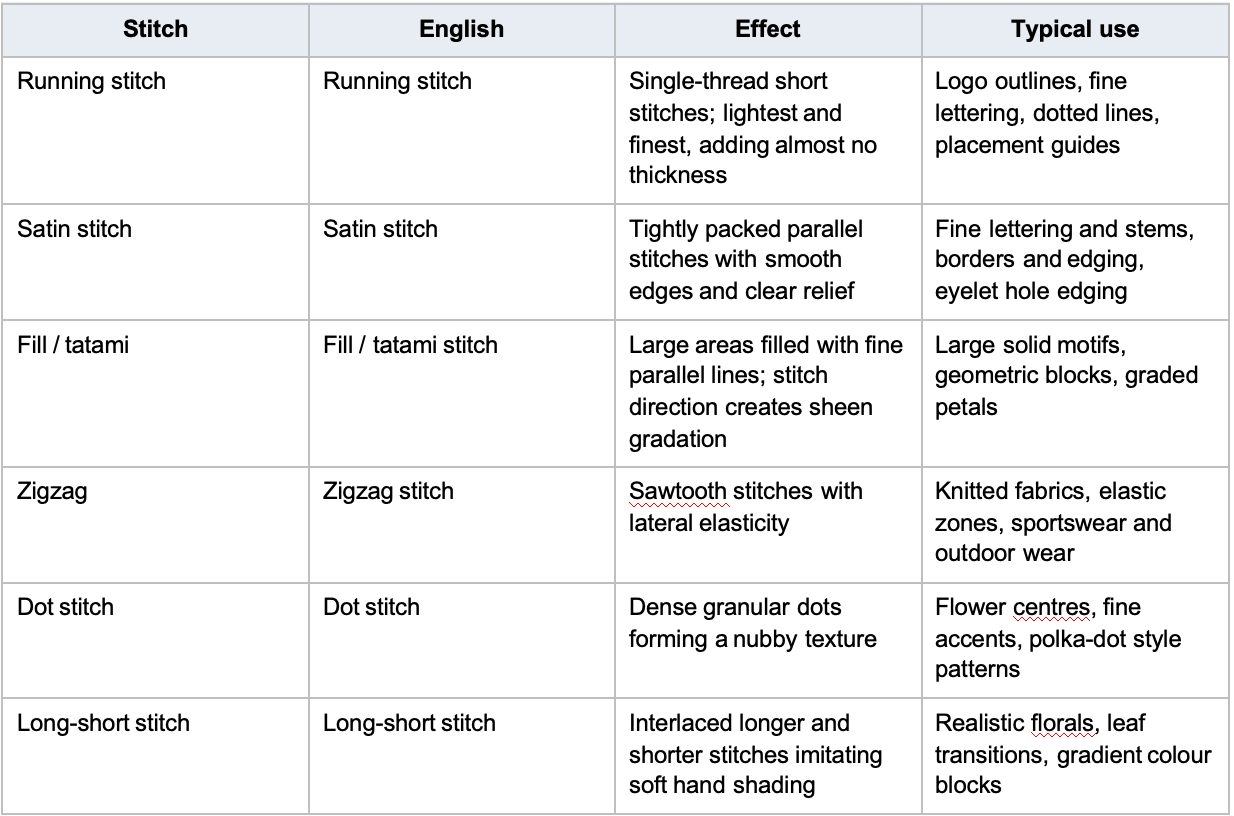
In practice, refined machine embroidery is almost always a mix of stitches: tatami or fill as the base, satin to define outlines and stems, running stitch for fine lines, and speciality stitches layered on the focal points. The digitising of stitch types and stitch sequence directly determines flatness, lustre and cost.
3.2 Base cloth suitability
· Tightly constructed, dimensionally stable woven cloth is the safest base for flat embroidery, giving the best pattern fidelity and flatness.
· For knits and elastic cloth, use a water-soluble or fusible backing and reduce stitch count and machine speed with controlled tension, so the cloth is not pulled out of shape.
· For high-shrink cloth, measure shrinkage first and feed it back into the digitising before finalising; otherwise the whole pattern shifts and repeating patterns show mismatched joins.
· Always run sample embroidery before bulk: confirm flatness, hand feel, shrinkage and performance after washing, then freeze the parameters into a process sheet.
4. Speciality Embroidery Processes
Speciality embroidery always requires dedicated devices or attachments, offers strong differentiation, and carries higher unit price and minimum order quantity than flat embroidery. Each process below is described by principle, effect, apparel applications and cautions.
4.1 3D / Puff embroidery
Principle and effect: padding material - EVA foam or sponge, typically 3-5 mm thick - is placed under the motif between the presser foot and the cloth, then fully enclosed by stitching, producing a distinctly raised, solid, three-dimensional shape with crisp outlines.
· Apparel use: large chest lettering on hoodies and baseball jackets, sportswear and workwear chest logos, childrenswear cartoon motifs, cap fronts, jacket branding, shoe uppers and bag panels.
· Cautions: pad thickness must match motif area - thin motifs padded too thickly collapse after washing. Avoid high-temperature pressing and prolonged stacking; heavy laundering is not suitable over the raised area. Pricing includes the padding and the extra step.
4.2 Applique embroidery
Principle and effect: a second fabric is cut to the motif shape, laid on the base cloth and fixed by stitching around the edge. Edged and cut-out applique variants create layering and offset depth; large colour blocks can be covered without filling them with thread, which is an effective way to control stitch count and cost.
· Apparel use: childrenswear cartoon motifs and letters, large colour-block graphics on casual wear and hoodies, patch decoration on denim and jackets, branding on down and padded jackets, animal and floral motifs on loungewear.
· Cautions: the applied fabric and base cloth should not differ too much in shrinkage, stretch, thickness or colour fastness, or bubbling and edge fraying will appear after washing. Applique edges must be trimmed cleanly and stitched down densely; dark appliques need a colour fastness test to avoid bleeding.
4.3 Towel and chain stitch embroidery
Principle and effect: in towel embroidery a hook pulls the thread from below to the face of the cloth in dense n-shaped loops, giving a soft looped pile rather like towelling - hence the alternative name loop-pile embroidery. Chain stitch embroidery forms patterns in continuous linked loops. The two are often produced on the same machine and can be combined with flat embroidery in one design.
· Apparel use: large chest lettering and back graphics on hoodies and baseball jackets, childrenswear and babywear, accents on knitwear and casual jackets, caps, letters and motifs on loungewear.
· Cautions: pile height and density determine hand feel, weight and cost. Too dense causes thread build-up and pilling after washing; too sparse loses the pile effect. When combined with sequins or beads, thread snagging must be avoided; looped areas tolerate little abrasion, so wash inside out in a bag.
4.4 Sequin embroidery
Principle and effect: a sequin device (dispenser) on the machine feeds sequins one by one onto the cloth; the needle pierces through the centre to anchor each sequin, then stitches back and forth around the outer edge to enclose it. Single-colour, two-colour and multi-colour versions exist, and sequins can be placed singly, partly overlapped or double-stacked, producing a dense, shimmering scaled effect - the highest decorative intensity among standard processes.
· Apparel use: all-over or focal sequinning on evening and party gowns (chest, back, waistline), bridal and stage wear, prom dresses, sequin tops and skirts, shoe uppers and bags, headwear.
· Cautions: sequins must be reasonably rigid, flat, smooth and glossy with clean edges to avoid snagging and thread cutting. They must be heat resistant and colourfast. MOQ is usually higher than flat embroidery because sequins must be stocked; weight and cost rise accordingly, high-temperature pressing must be avoided, and the surface should not rub against rough materials.
4.5 Bead and bugle bead embroidery
Principle and effect: beads of a specified shape and size - glass beads, bugle beads, pearls, claw stones - are strung into a cord-like feed and stitched onto a flat machine fitted with a bead device. The result has the weight and texture of hand-applied stonework, with fine, dense lustre and deep layering.
· Apparel use: bridal and couture bodices, shoulders, cuffs and waistlines, veils; heavily embellished evening and party wear; fine bead accents on lingerie and loungewear; bags and shoe uppers.
· Cautions: use high-tenacity beading thread and never too fine a thread, or the strand breaks and beads are lost. Beads must have smooth, rounded holes and be heat resistant and environmentally compliant. Weight and care requirements rise sharply: hand wash or dry clean, never machine spin; avoid large areas of hard beadwork against the skin.
4.6 Ribbon / tape embroidery
Principle and effect: ribbon, satin band, gauze tape or decorative tape is laid in the motif shape and fixed by stitching down the centre or along both edges. Because the tape itself has width and lustre, the motif is full and three-dimensional with a soft, romantic character.
· Apparel use: three-dimensional flowers on dresses and tops, decoration on gowns and bridal, floral patterns on knitwear and jackets, childrenswear, bags and headwear.
· Cautions: the matching tape attachment is required; common tape width is about 2.0-9.0 mm and thickness about 0.3-2.8 mm, beyond which feeding becomes difficult. Tape must first be edge-finished by rolling, overlocking or laser slitting to prevent fraying; tape that is too thick or stiff cannot be used. Cut fabric strips should not be too thick or stiff, and natural fibres that do not fray may be left raw.
4.7 Cord embroidery
Principle and effect: a thicker cord or woven tape is laid along the motif and fixed with fine thread, commonly in a twin-needle cording structure, forming a clear three-dimensional line and a bold outline - highly recognisable in casual and streetwear styles.
· Apparel use: denim back pockets and plackets, outline lines on casual wear and jackets, letters and slogans on hoodies, line decoration on baseball jackets.
· Cautions: cord diameter must match needle position and the feeding device; slow down on turns and tight curves to avoid skipped stitches and thread build-up. Thick cord adds noticeable thickness to the motif, so garment fit and pressing requirements must be confirmed.
4.8 Toothbrush embroidery
Principle and effect: after conventional stitching, specific areas receive a dedicated treatment that makes the threads stand up like bristles, giving a three-dimensional brush-like or short-pile feel. It can be combined with flat embroidery to enrich the pattern.
· Apparel use: childrenswear, casual wear and streetwear motifs, letters and animal graphics, bags and shoe uppers.
· Cautions: special materials and an additional finishing step are required, so cost exceeds flat embroidery. Consistency of pile height and standing effect is the key quality criterion; the pile flattens after washing, so gentle bag washing is recommended.
4.9 Hollow 3D embroidery (water-soluble padding)
Principle and effect: water-soluble padding is placed under the motif and dissolved away after stitching, leaving a hollow, light yet three-dimensional structure in thread. Compared with foam-backed 3D embroidery the hand is softer, the base cloth does not stiffen, and the cloth keeps its original stretch and softness - it also preserves the inherent softness of thicker or wool yarns.
· Apparel use: raised florals on light womenswear and shirts, dimensional focal points on dresses and gowns, knitwear and other stretch fabrics, childrenswear.
· Cautions: the padding must be dissolved completely; residual film makes the motif stiff and dull. Dissolving temperature and time depend on the padding type, and a second rinse bath is required. A preferred process where base-cloth hand feel matters.
4.10 Eyelet (cut-work) embroidery
Principle and effect: an eyelet knife or needle punches or cuts the base cloth along the motif, the freshly cut yarn ends are immediately bound by edging stitches, and the face is then filled with flat embroidery - producing solid motifs and open holes side by side. The holes genuinely let light through, which printing cannot imitate.
· Apparel use: dresses, shirts and shirt-dresses, blouses and camisoles, skirts and suits, bridal gowns, childrenswear (subject to the relevant safety standards); collar, placket, hem and cuff decoration and panel joins.
· Cautions: only firmly constructed, reasonably dense cloth is suitable. Sparse or low-density cloth such as thin chiffon frays at the opening and the edging falls away. Hole diameter, spacing and open-area percentage are hard constraints - once exceeded, no machine adjustment downstream can compensate. The open structure snags easily, so roll on paper tubes, and every metre must pass needle detection.
4.11 Water-soluble embroidery and guipure lace
Principle and effect: the design is stitched on hot-water-soluble or cold-water-soluble film, either in the piece, shaped to a panel, or as a lace band; the substrate is then dissolved, leaving a lace-like motif made purely of thread, transparent, light and with a dimensional outline.
· Apparel use: lace motifs and edging bands on gowns and bridal, lace panel inserts on dresses and tops, lingerie and loungewear edging, collar and cuff appliques, veils.
· Cautions: hot-water film only dissolves after boiling, is lower cost and is the conventional choice; cold-water film dissolves in water but costs more. Threads at the joins of the motif must not be too fine or they break. Because a single embroidery thread has limited length, piece embroidery inevitably contains knots which cannot be avoided - cut around them where possible. The result is very light, so handle and wash gently.
4.12 Mesh and tulle embroidery
Principle and effect: mesh, net or organza is used directly as the base, so the motif floats above the mesh openings. The result is highly translucent and light - the core process for bridal and gown overlays.
· Apparel use: bridal gowns and veils, evening and prom gown overlays, lace-insert upper bodies, stage and performance wear, overblouses and light outer layers.
· Cautions: a water-soluble or dedicated backing is required to stabilise the mesh and prevent displacement and mesh distortion; tension control is demanding and machine speed should be reduced. Mesh has limited strength of its own, so motifs should not be excessively dense or the mesh may tear.
4.13 Hand embroidery (Su embroidery, gold thread couching, tambour)
Principle and effect: stitched by hand from the artwork, giving flexible stitching and fine layering, achieving soft gradations and reversible effects machines cannot match. Gold thread couching stitches metal thread onto the cloth for strong lustre and formal motifs; tambour / Luneville hook work carries thread from the reverse and chains beads, sequins and claw stones on the face, a signature couture technique.
· Apparel use: new Chinese style and national-style gowns, couture and limited editions, focal areas of heavily embellished gowns and bridal, stage costume and high-value apparel.
· Cautions: high labour cost and long lead time - suited to small, high-value orders. The standard cost-control approach is machine embroidery for the mass and handwork for the accents: large and regular patterns by machine, focal points by hand.
4.14 Combined processes
· Printing plus embroidery: print supplies the colour and gradient base, embroidery supplies the dimensional focus; common in streetwear, childrenswear and casual wear.
· Embroidery plus hotfix stones or transfers: stitching forms the outline and body, stones and transfers add sparkle; common in partywear, stage costume and denim.
· Embroidery plus laser cutting: the laser cuts fine outlines or open lettering and stitching reinforces the outline for contrast; common in denim and streetwear.
· Embroidery plus flocking: stitching frames an area which is then flocked for a velvet-touch motif; common in childrenswear and gift apparel.
· Embroidery plus quilting or padding: stitching through a padded layer creates quilted lines and dimensional panels; common in outerwear and padded jackets.
Cautions: layering processes amplifies changes in shrinkage, hand feel and weight and increases steps and waste. Always confirm overall effect and care performance on a sample before committing the bulk route.
5. Apparel Applications
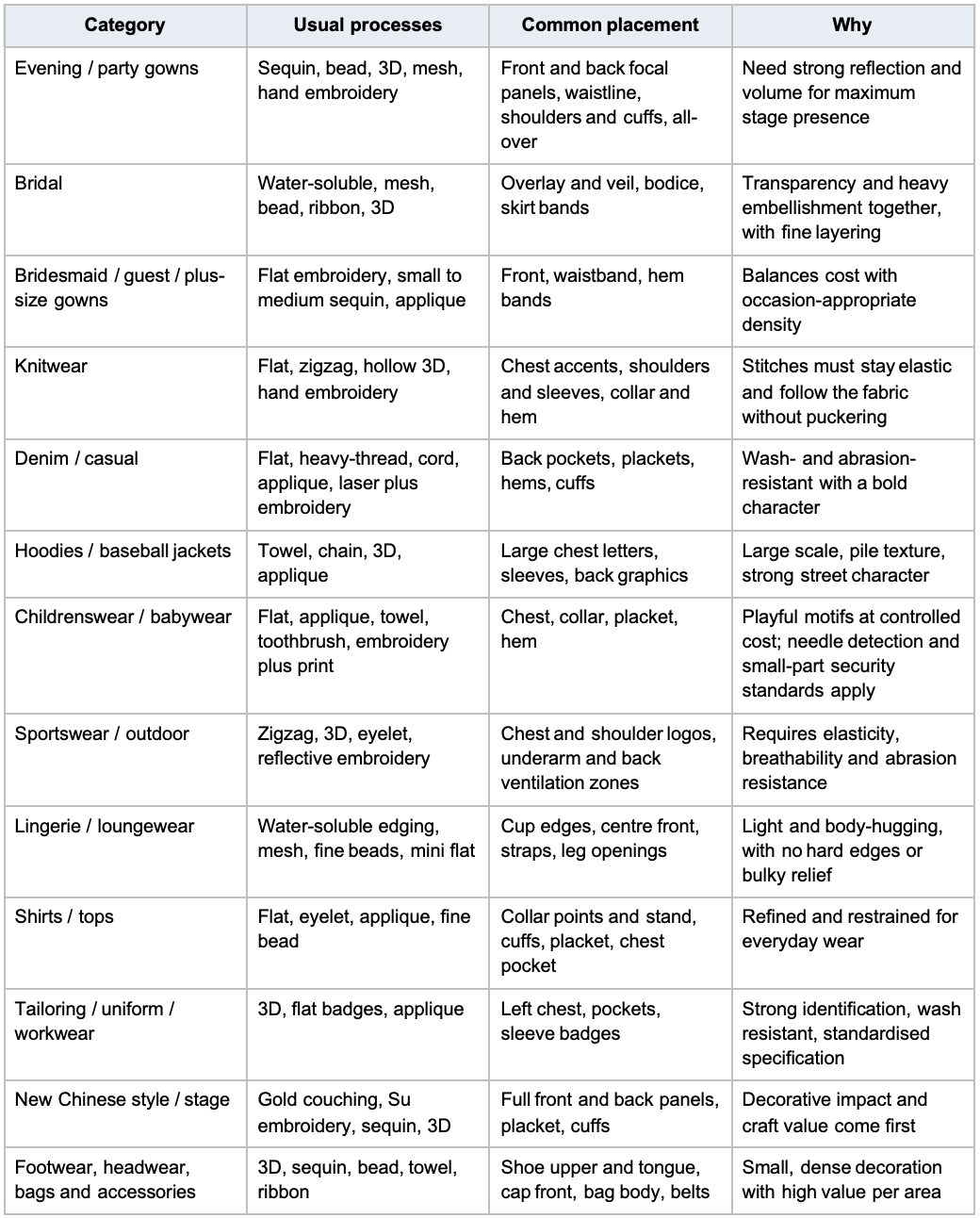
5.1 By garment category
5.2 By garment area
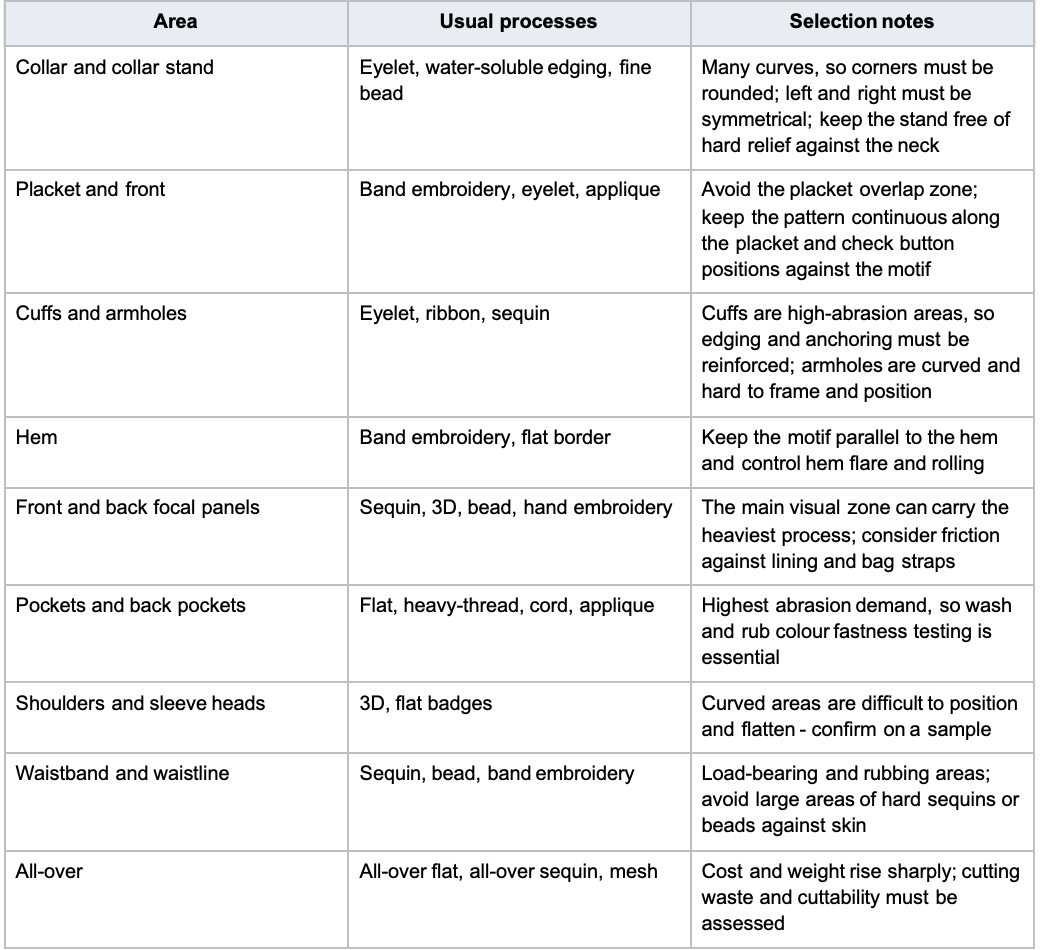
6. Sourcing Points for Embroidery Fabric
· Pricing basis: the industry prices by stitch count - a unit price per thousand or ten thousand stitches multiplied by total stitches - plus colour count, sequins and beads, applique, backing and finishing charges. Pattern density, colour count and trim consumption are therefore the three pricing variables: changing the design changes the price, so confirm the stitch count on the tape before quoting.
· Weight gain: embroidery adds thread to the cloth, so finished weight is always above greige and rises with density. This directly affects garment weight, drape and cost and must be calculated together with the base weight at development stage.
· Shrinkage and pattern position: dense embroidery causes stitch shrinkage, so finished width and pattern position change relative to greige. For piece embroidery, grading must be redone from measured post-embroidery shrinkage and position - greige patterns cannot be reused directly.
· Cuttability and waste: all-over, scattered and positioned patterns differ greatly in layout waste. Positioned patterns in particular need motif marks and registration marks on the pattern, plus allowance for matching.
· Base cloth match: fabric construction, elasticity and shrinkage determine which processes are possible. Sparse or highly elastic cloth should be sampled first to verify edge and motif stability.
· Care and testing: sequins, beads, applique and eyelet structures require more careful handling than plain flat embroidery, and this should be stated in the garment care label. Childrenswear requires needle detection and small-part security testing. Where water- and stain-repellent finishes are involved, note the restrictions on PFAS-type substances in the destination market (refer to the latest official texts for exact scope and effective dates).
7. Quick Process Selection Guide
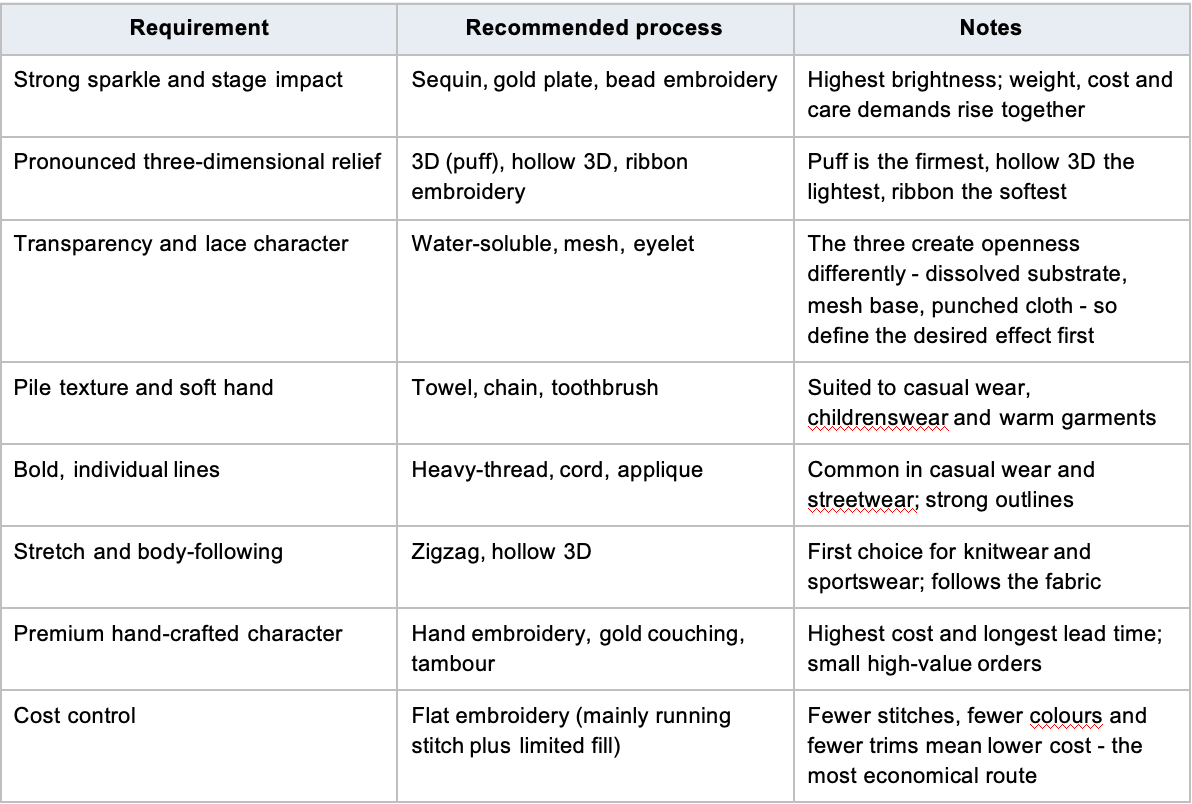
8. Common Problems and Remedies
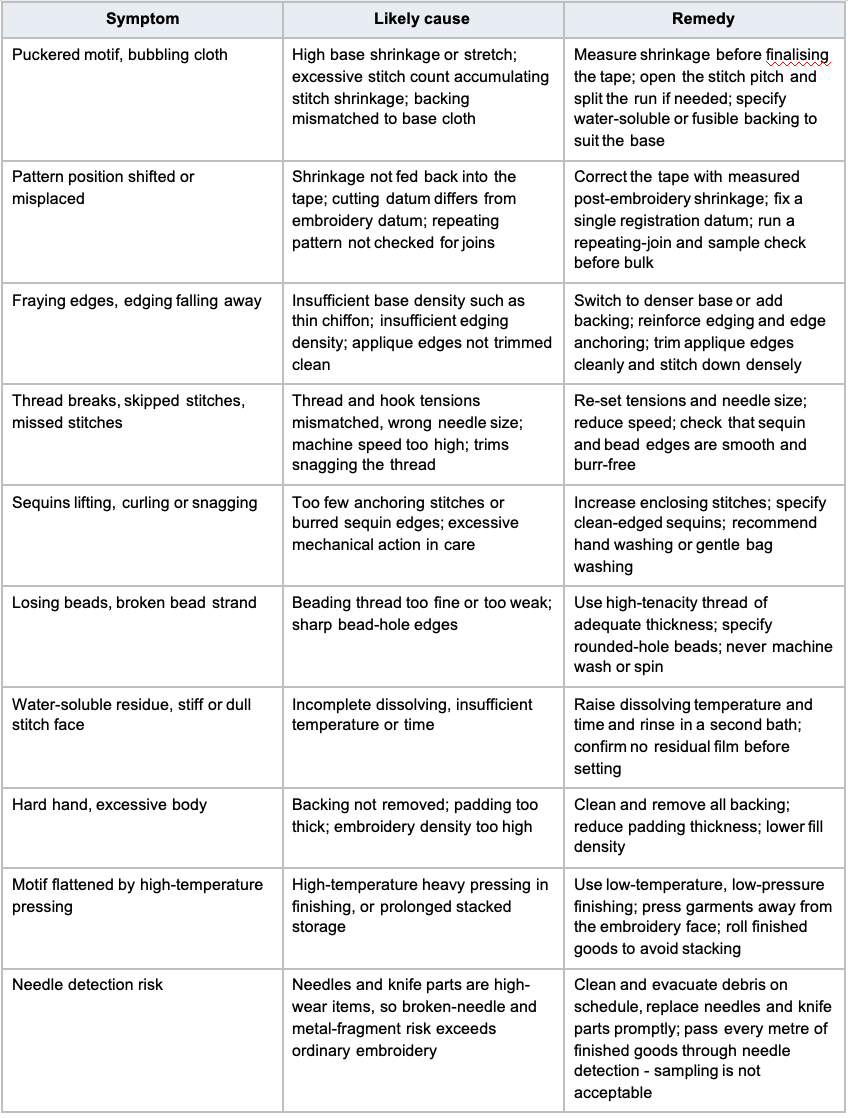
9. Notes
1. This document summarises embroidery process types and apparel applications. The contents are industry-typical practice and ranges; actual parameters must be confirmed by sampling for each order according to base material and weight, motif, thread specification, trims and machine condition, then frozen into a process sheet.
2. Fibre content, width, weight and other specifications are subject to the order confirmation; no specification commitment is made here. Embroidery changes finished weight and usable width relative to greige, so measured values from the embroidered sample prevail.
3. Statements about care and durability are best supported by third-party testing or measured results.
4. All processes and applications discussed here relate to apparel use.

Jiede as one of the experienced apparel fabric manufacturer which can help you solve all your needs and problems in fashion fabrics.
CONTACT US
Contacts: Candy
TEL: 86-18158661662
Email: candy@jiedetextiles.com
WhatsApp: 86 18158661662
Address: Room 6068, Building 9b, China Textile City Creative Park, No.199 Chuangyi Road, Keqiao, Shaoxing, Zhejiang, China.